


HSC Chemistry Module 5: The Equilibrium Guide | Tutorio

Dr Andrew Wotherspoon • July 13, 2026

Share this article

New paragraph

Most students who lose marks in Module 5 know the chemistry. They know the equilibrium shifts right. What they cannot do is show why — and in an HSC long-response question, an unjustified correct answer is a 1-mark answer.

Equilibrium is a dynamic state: the forward and reverse reactions continue at equal rates within a closed system. Nothing has stopped. Understanding that is the first hurdle. Le Chatelier's Principle is how you predict what a system will do when you disturb it. The CORE™ Method is how you write it down so a marker can award full marks. This guide covers both.

What is the difference between static and dynamic equilibrium?

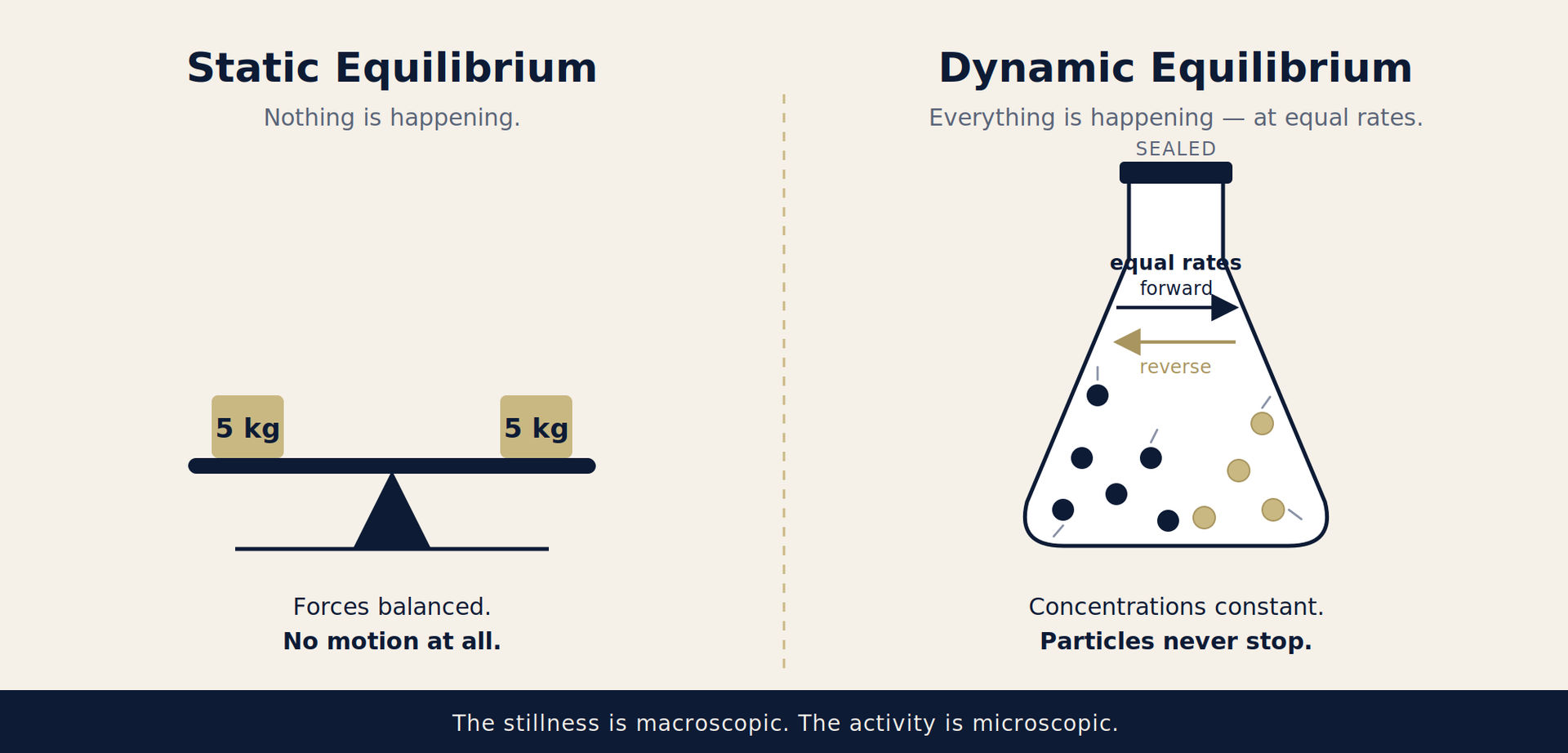
The distinction between static and dynamic systems is the first major hurdle in Module 5. Static equilibrium occurs when all movement within a system has ceased, on both a macroscopic and a microscopic level — a balanced see-saw is the standard example. Opposing forces are equal, there is no net movement, and there is no movement at all. The system is at rest.

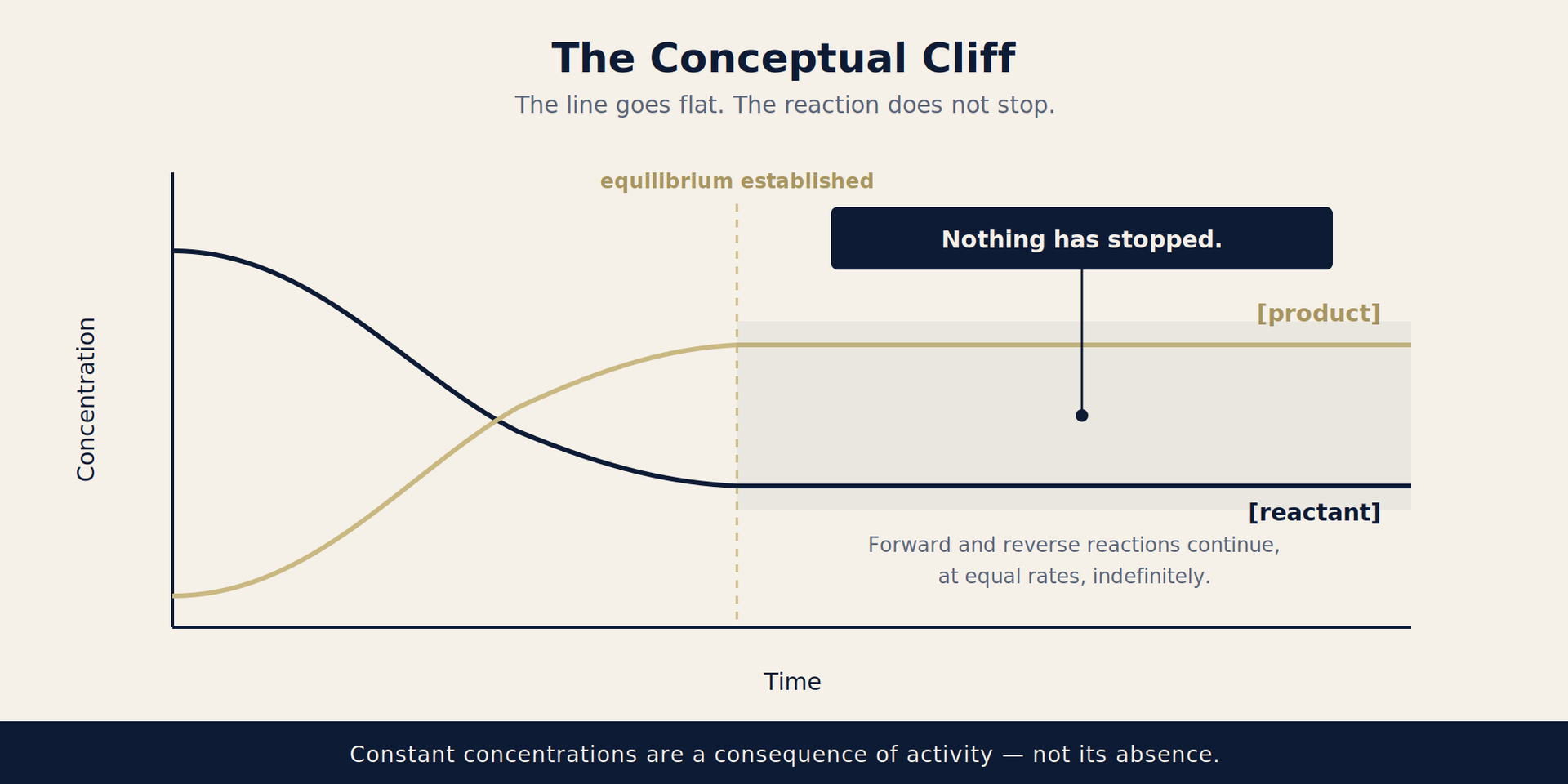
Dynamic equilibrium is not more complicated than static equilibrium — it is more counter-intuitive. The reaction has not stopped. The forward and reverse reactions are both proceeding, continuously, at exactly the same rate. This is why the concentrations of reactants and products remain constant: not because nothing is happening, but because the two processes cancel. Beneath the constant concentrations, particles are in continuous exchange. Bonds break and form at every moment. Understanding this invisible activity is the whole of Module 5.

Dynamic equilibrium requires a closed system: no matter may enter or leave, though energy may still be exchanged. Where students struggle is not with this condition but with the picture it demands. Their eyes see a still solution. Their minds must hold a chaotic, balanced storm of molecular collisions. That transition — from visible stillness to invisible action — is the conceptual cliff, and it is where most of Module 5 is won or lost.

Mastering the Conceptual Cliff in Year 12

Moving from Year 11 to Year 12 Chemistry demands a significant increase in abstract reasoning. In Year 11, reactions are presented as one-way streets: mix A and B, obtain C. Module 5 requires students to accept that most chemical processes are reversible — and, harder still, that forward and reverse can run simultaneously, in balance, in the same vessel. It is that simultaneity, not reversibility alone, that produces the conceptual cliff.

Navigating this cliff requires molecular-level intuition. You are no longer balancing equations on paper and stopping; you are reasoning about a system in which two competing processes run at once and settle into balance. The cliff arises because students apply static logic — expecting a reaction to finish — to a system that never finishes. It arrives at a stable state and stays there, still reacting.

The students who succeed in this module are the ones who stop asking "What is the answer?" and start asking "What is the system doing?" That shift is not a study technique — it is the difference between memorising outcomes and being able to predict them.

Building this mental model early matters, because the quantitative half of Module 5 depends on it. Once you can picture two competing rates settling into balance, the equilibrium constant (Keq) stops being an isolated maths problem and becomes what it actually is: a number that tells you where that balance sits.

Static versus dynamic equilibrium — a balanced see-saw at rest beside molecules colliding in a sealed flask

How does Le Chatelier’s Principle predict reaction shifts?

Le Chatelier's Principle states that if a system at equilibrium is subjected to a change in conditions, the system will shift its equilibrium position so as to partially counteract that change. It is a predictive tool rather than a law — it holds reliably across the systems you will meet in the HSC — and it is the cornerstone of Module 5, appearing in almost every examination.


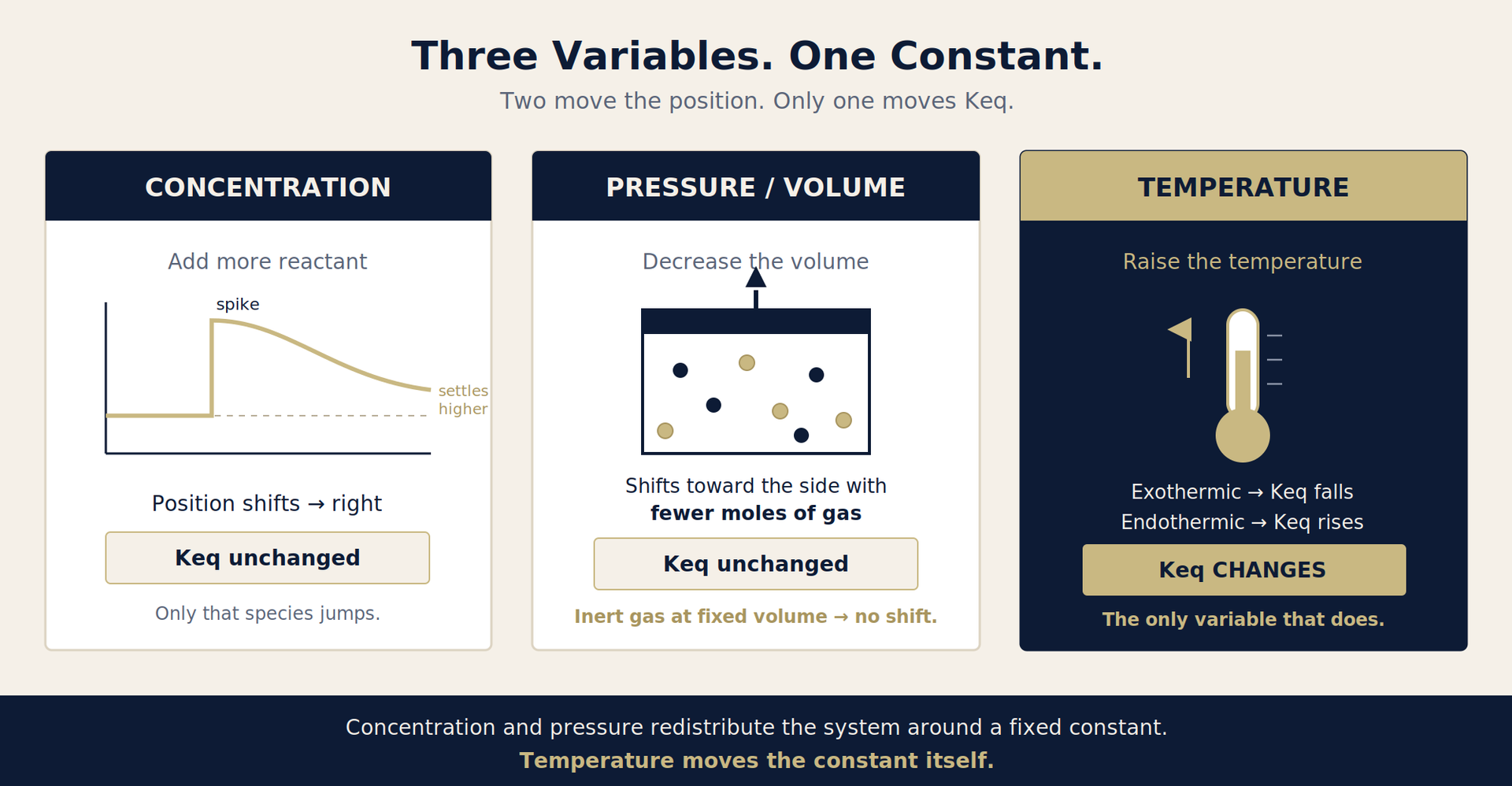
Three variables can impose that change. Two of them move the equilibrium position. Only one moves the equilibrium constant.

  1. Concentration — adding or removing a reactant or product. Shifts the equilibrium position; Keq is unchanged.
  2. Pressure / volume — relevant only to gaseous systems, and only where the two sides of the equation contain different numbers of moles of gas. Note that the pressure must be changed by altering the volume; adding an inert gas at constant volume raises the total pressure but shifts nothing. Position moves; Keq is unchanged.
  3. Temperature — the only variable that changes the value of Keq. Everything else redistributes the system around a fixed constant. Temperature moves the constant itself.
Le Chatelier diagram — concentration and pressure shift equilibrium position; only temperature changes Keq

Faced with a pressure increase, a student must first identify which side of the equation contains fewer moles of gas. The system shifts toward that side, reducing the total particle count and relieving the applied pressure.

This sounds mechanical, and it is — until the word partially is taken seriously. The system does not undo the change. It offsets some of it. Add more reactant and the system will consume a portion of what you added, but the reactant's new equilibrium concentration remains higher than it was before you interfered. The disturbance is blunted, never erased.


This is what graphing questions are testing. For a concentration change, one species jumps vertically at the moment of addition, then decays gradually — but settles above its original line, not back on it. For a volume decrease, every species jumps at once, then redistributes. Knowing which curve the question wants is half the mark.

Introducing the CORE™ Method for HSC Chemistry

Knowing that the equilibrium shifts right is not the same as being able to say why in a way a marker can award marks for. Le Chatelier's Principle gets you the prediction. The CORE™ Method gets you the marks.

It is a structure, not a shortcut — four steps that convert a correct instinct into a complete response. Applied to any equilibrium shift question:

  1. Concept — name the principle you are applying (Le Chatelier's Principle, Collision Theory).
  2. Observation — state the specific change imposed on the system. "The temperature of the system is increased."
  3. Reasoning — explain why the system responds as it does, grounded in the principle you named. "The forward reaction is endothermic. The system shifts forward, absorbing energy, partially counteracting the temperature increase."
  4. Evidence — state the outcome, and what happens to Keq. "The equilibrium position shifts right, increasing product concentration. Because temperature has changed, Keq increases."

CORE™ exists to stop you skipping the why. Markers are not testing whether you can name the direction of the shift — most students can. They are testing whether you can justify it. The structure forces the justification into the answer, where the marks are.

Here is what that looks like in practice.

Example: Putting CORE™ into Practice

Question: A mixture of nitrogen and hydrogen reaches equilibrium in a sealed vessel. The volume of the vessel is then decreased, increasing the total pressure. Explain the effect on the equilibrium position.

N 2 (g) + 3H 2 (g) ⇌ 2NH 3 (g)   ΔH < 0

The typical response (Band 3–4):

“Increasing the pressure makes the reaction shift to the right to make more ammonia because there are fewer gas moles on that side.”

The direction is correct, but the response asserts the outcome without justifying it. There is no principle named, no mechanism, and no statement of what happens to the equilibrium constant. A marker cannot award full marks for a conclusion that arrives without reasoning.

The CORE™ response (Band 6):

  • Concept: Le Chatelier’s Principle states that a closed system at equilibrium subjected to a change in conditions will shift its equilibrium position so as to partially counteract that change.
  • Observation: The volume of the vessel has been decreased, increasing the total pressure by increasing the concentration of all gaseous species.
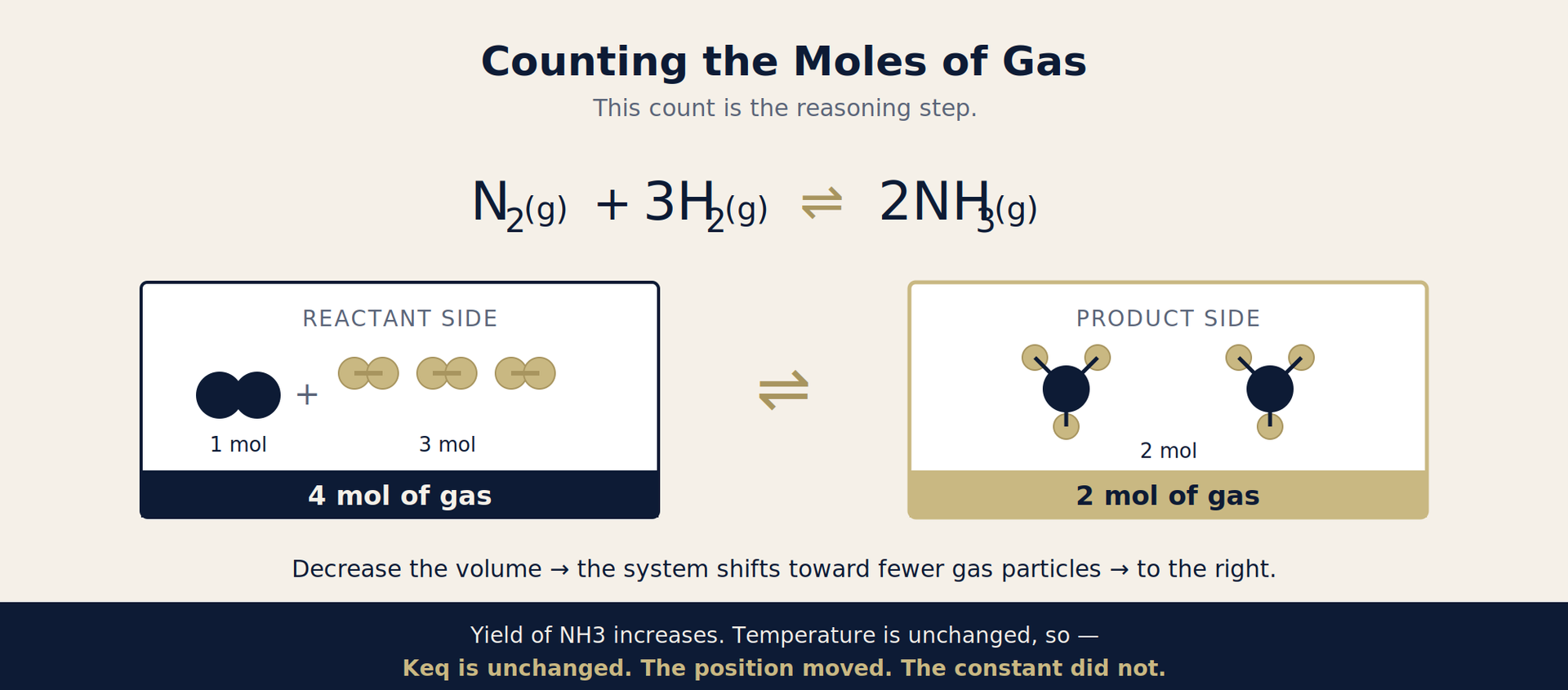
  • Reasoning: The system counteracts the increase in pressure by reducing the total number of gas particles. The reactant side contains 4 mol of gas (1 mol N 2 + 3 mol H 2 ); the product side contains 2 mol (2 mol NH 3 ). Shifting toward the products therefore reduces the particle count and relieves the applied pressure.
  • Evidence: The equilibrium position shifts to the right, increasing the yield of NH 3 . Critically, K eq is unchanged — the temperature has not been altered, and only temperature changes the value of the equilibrium constant. The system settles at a new position, not a new constant.

Why this scores: the marker sees a named principle, an identified change, a mechanism grounded in mole ratios, and an explicit statement distinguishing position from constant. That final distinction is the single most common omission in Band 5 responses.

A note on the trap: had the pressure been increased by adding an inert gas at constant volume , the partial pressures of N 2 , H 2 and NH 3 would be unchanged and there would be no shift. The question must always be read for how the pressure was raised.

HTML here
Haber process mole count — 4 mol of gas on the reactant side, 2 mol on the product side, N2 + 3H2 to 2NH3

Why do students struggle with Module 5 Equilibrium?

Module 5 is difficult because its questions rarely test one thing. A single equilibrium problem can ask you to construct an ICE table (stoichiometry), reason about a volume change (gas behaviour), determine whether Keq moves (thermochemistry), and then sketch the concentration–time curve (graphing) — in sequence, in one answer. Each step is manageable alone. The cognitive load comes from holding all four at once, and it is where most marks are lost: not on the chemistry, but on the integration.

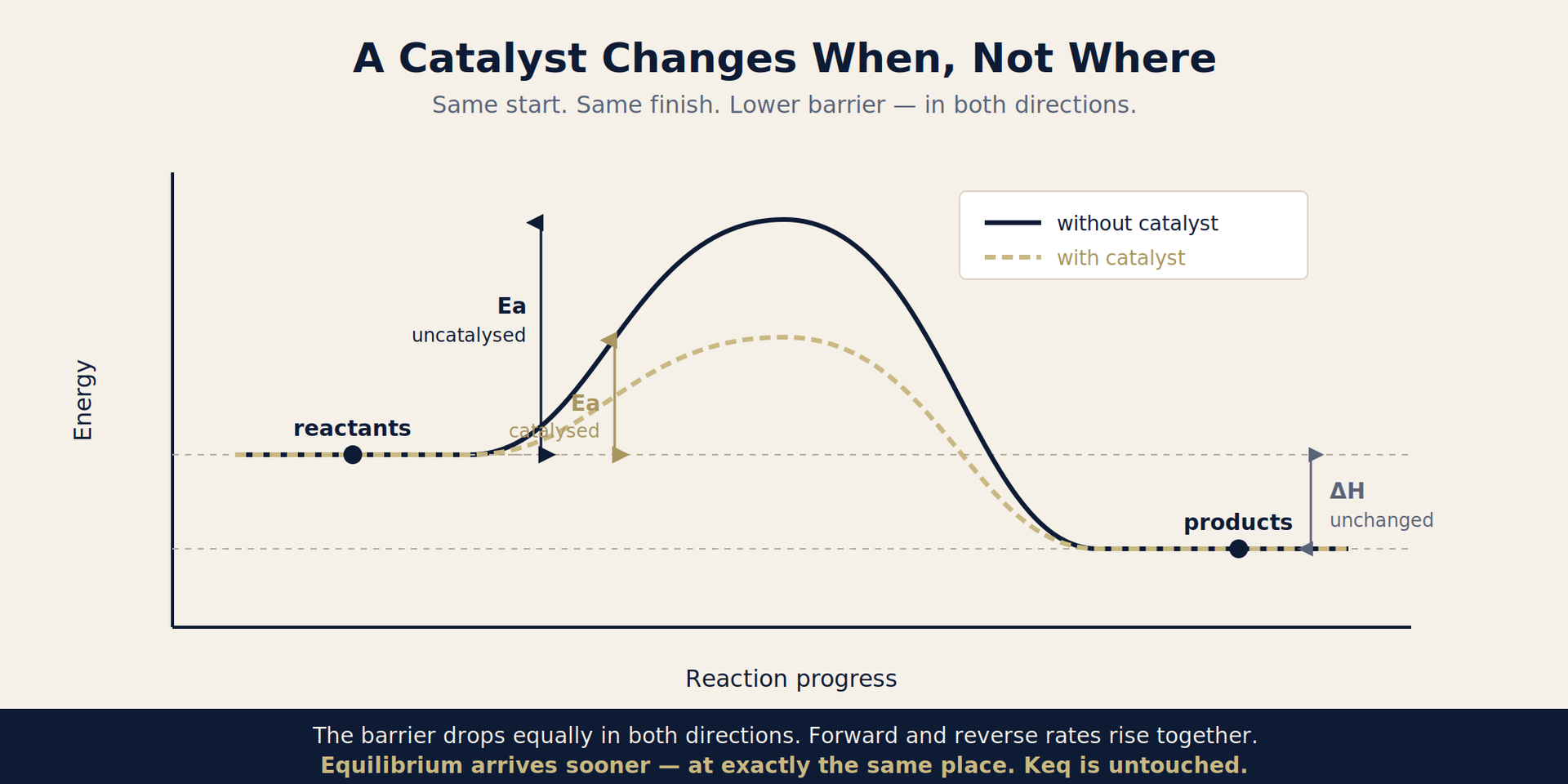
Catalysts are the other reliable trap. Many students believe a catalyst shifts the equilibrium position. It does not. A catalyst lowers the activation energy of the forward and reverse pathways by the same amount, accelerating both to the same degree. The system therefore reaches equilibrium sooner, but arrives at exactly the same place: neither the equilibrium position nor the value of Keq is altered.

A catalyst changes when you get there. It does not change where.

Catalyst energy profile — activation energy lowered equally in both directions, delta H and Keq unchanged
Tutor explaining CORE Method

Common pitfalls in equilibrium calculations

The theory is qualitative; the application is not. For the general reaction

aA + bB ⇌ cC + dD

the equilibrium constant is

K eq = [C] c [D] d ÷ [A] a [B] b

— products over reactants, each concentration raised to the power of its coefficient in the balanced equation. Every error below is a failure to apply that expression exactly as written.

  • Incorrect stoichiometry: forgetting to raise each concentration to the power of its coefficient. [NH 3 ] 2 , not [NH 3 ].
  • Ignoring states of matter: including solids (s) or pure liquids (l) in the expression. Their concentrations are effectively constant and are absorbed into K eq . Only gases (g) and aqueous species (aq) appear.
  • Units confusion: failing to convert grams to moles, or millilitres to litres, before calculating concentration (c = n/V). K eq is built from mol L −1 , not from whatever the question happened to give you.
  • Temperature neglect: forgetting that K eq holds only at the temperature stated. A K eq value quoted at 400 °C tells you nothing about the same system at 500 °C.
  • Q versus K: the reaction quotient Q has the identical algebraic form to K eq , but is calculated from concentrations at any instant, not only at equilibrium. The comparison is the whole point: Q < K → the reaction proceeds forward. Q > K → it proceeds in reverse. Q = K → the system is at equilibrium.

The defence against all five is procedural: write the K eq expression out in full before a single number is substituted. It forces you to check the coefficients and the states of matter at the moment you are least likely to be careless — before you have committed to an answer.

How can you visualise dynamic molecular systems?

Visualisation is a powerful tool for Module 5, because you cannot see what you are being asked to reason about. Analogies fill the gap.

Picture a busy airport terminal with two sets of automatic doors. People enter through one and leave through the other. When the rate of arrival equals the rate of departure, the number of people inside the terminal stays constant — and stays constant indefinitely — even though nobody is standing still. Crucially, the five hundred people inside at 3pm are not the same five hundred who were inside at 2pm. The count is stable; the population is not. That is dynamic equilibrium.

The analogy has a limit worth naming: it tells you the terminal population is stable, but not why it settles at five hundred rather than five thousand. That number — the position the system settles at — is Keq.

A second technique is drawing Collision Theory diagrams. Increase the concentration of a reactant and you increase the number of particles per unit volume — so collisions between reactant particles become more frequent. The proportion of collisions with sufficient energy to react is unchanged, but there are simply more of them, so the forward rate rises. The system responds until the two rates are equal again.

This is why Le Chatelier's Principle works. It is not a rule imposed on chemistry from outside; it is what falls out of collision behaviour when you disturb a balanced system. Understanding the mechanism beneath the principle is what allows you to apply it to a system you have never seen before — which is what an exam is.

The Impact of Temperature on Keq

Temperature is unique: it is the only variable that changes the value of the equilibrium constant. Everything else in Module 5 redistributes the system around a fixed Keq. Temperature moves Keq itself.

The standard device is to treat heat as though it were a chemical species. For an exothermic forward reaction, heat sits on the product side. Raise the temperature, and you have, in effect, added product — so the system shifts left, running the endothermic reverse reaction to absorb the added energy. Product concentrations fall, reactant concentrations rise, and Keq is therefore smaller.

The device works, but understand what it conceals. Heat is not a species and does not appear in the Keq expression. That is precisely why the constant changes rather than the position merely shifting: there is no term in the expression for the system to redistribute against. The ratio itself is forced to a new value.

For an endothermic forward reaction, the logic inverts. Heat sits on the reactant side; raising the temperature adds reactant; the system shifts right; Keq increases.

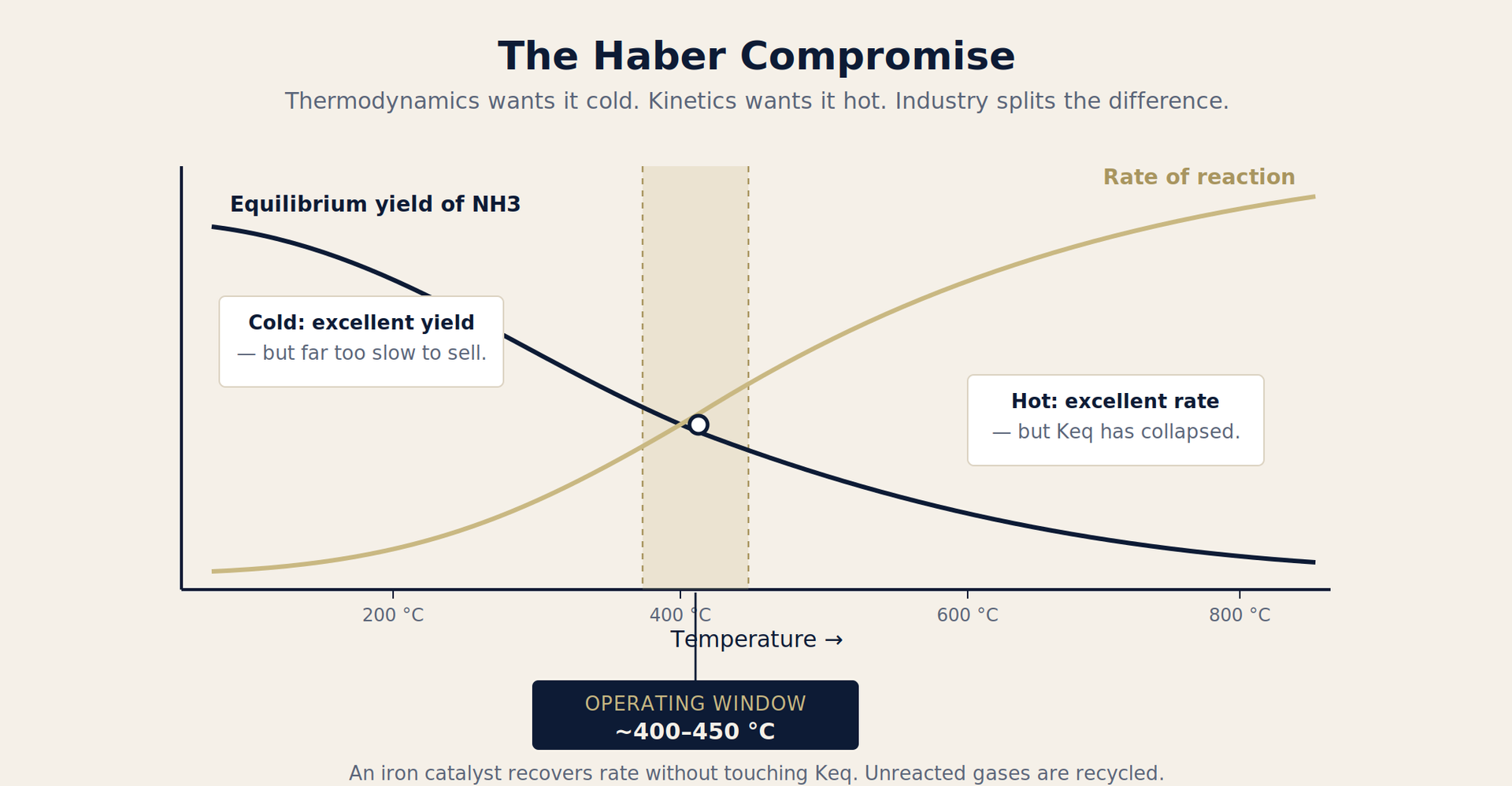
This is where Module 5 turns industrial. The Haber process is exothermic, so thermodynamics wants a low temperature: cooler means a larger Keq and a higher equilibrium yield of ammonia. Kinetics wants the opposite — a low temperature means a low rate, and an excellent yield achieved over three weeks is worthless. Industry does not resolve this. It compromises: roughly 400–450 °C accepts a poorer equilibrium yield in exchange for reaching it quickly, and an iron catalyst is used to claw back rate without touching Keq at all. The unreacted gases are then recycled.

Long-response questions on the Haber or Contact process are testing exactly this: whether you can hold yield and rate in tension and justify a compromise, rather than reciting one side of it. A student who writes "low temperature increases yield" has answered half the question.

Student studying reaction shifts

Expert Strategies for HSC Success

Module 5 is not hard because the chemistry is obscure. It is hard because the system you are describing does not behave the way your intuition insists it should — it never stops, it never fully undoes a disturbance, and only one of the three variables you can change touches the constant at all.

The students who do well are not the ones who have memorised more. They are the ones who can look at a disturbed system, work out what it will do, and then write it down in a form a marker can award marks for. Le Chatelier gives you the first. CORE™ gives you the second.

Key Takeaways for Module 5 Mastery:

  1. Equilibrium is equal rates, not equal concentrations. Nothing has stopped. The concentrations hold steady because the two reactions cancel, not because the reactions ceased.
  2. Only temperature changes Keq. Concentration and pressure move the equilibrium position around a fixed constant. Temperature moves the constant itself.
  3. "Partially" is the load-bearing word. A disturbed system offsets a change; it never erases it. The new equilibrium concentration is never the old one.
  4. Read how the pressure was changed. Volume decrease shifts the system. Adding an inert gas at constant volume does not.
  5. A catalyst changes when, not where. It reaches equilibrium sooner and arrives at exactly the same place.
  6. Write the Keq expression before substituting anything. It forces you to check coefficients and states of matter while you can still afford to.
  7. Structure every long response with CORE™. Concept, Observation, Reasoning, Evidence — and state what happens to Keq in the Evidence step.

Everything above is how I teach Module 5 — the distinction between position and constant, the CORE™ structure, the specific traps markers set. If it was useful, that is what a session looks like.

Tutorio runs face-to-face from the Camperdown studio and online across Australia. Tell me the student's year, curriculum, and the subjects they're struggling with, and I'll come back to you.

Recent Posts

Professional online tutoring setup for HSC Science and Mathematics with advanced digital tools.
May 31, 2026
Explore the essential attributes of the best online tutoring for HSC Science and Maths, focusing on PhD-led instruction, cognitive load theory, and exam strategy.

A PhD tutor using a Macbook for tutoring
By Dr Andrew Wotherspoon May 24, 2026
Discover how PhD-led STEM tutoring uses Bloom's 2-Sigma research to eliminate conceptual blind spots and maximise student performance in HSC and IB exams.

An avenue of trees in a forest symbolising a different path to teaching for neurodivergent students.
By Dr Andrew Wotherspoon April 21, 2026
Supporting neurodivergent science learners. Practical strategies for educators and families to unlock STEM success.

Two scientists in white lab coats, one holding a test tube with blue gloves in a lab setting.
By Dr Andrew Wotherspoon April 21, 2026
Why chemistry feels impossible and how CORE™ Framework solves it. A parent's guide to Johnstone's Triangle and rigorous pedagogy.

HSC Chemistry Module 5 Misconceptions infographic style image
By Dr Andrew Wotherspoon April 21, 2026
Identify and fix the 5 most common HSC Chemistry Module 5 misconceptions. Learn how Tutorio's PhD-led approach uses Johnstone's Triangle for student success.

Specialized chemistry support for neurodivergent students using diagnostic reasoning.
By Dr Andrew Wotherspoon April 21, 2026
Expert guide for families of neurodivergent students (ASD, ADHD) struggling with Chemistry. Learn how specialized diagnostic tutoring and scaffolding help learners succeed in secondary science.

Comparison of IB and HSC/VCE curriculum pathways for elite students.
By Dr Andrew Wotherspoon April 9, 2026
A PhD-led expert guide comparing the IB Diploma with HSC and VCE pathways. Analyze ATAR scaling, workload demands, and curriculum depth to choose the right senior secondary route for elite university entry.
Primary school student focused on academic learning and cognitive development.
April 5, 2026
Discover why building cognitive architecture in Years 1-6 is essential for high-performance HSC, IB, and Selective School results. Move beyond the catch-up mentality.

PhD-led science tutoring session illustrating cognitive architecture in learning.
April 5, 2026
Discover how PhD-led science tutoring in Sydney uses cognitive architecture to move beyond information transfer and secure elite HSC and IB results.

Sophisticated fountain pen writing on parchment representing elite English essay strategy
April 2, 2026
Discover why B+ students fail to reach Band 6 in HSC/VCE English and how a PhD-led synthesis approach breaks the generic essay ceiling for elite ATAR results.
Show More