
5 HSC Chemistry Module 5 Misconceptions to Fix
HSC Chemistry Module 5 misconceptions often stem from a fundamental misunderstanding of dynamic equilibrium, where students incorrectly assume reactions stop or that concentrations must be equal. By applying Johnstone’s Triangle—balancing macroscopic observations, sub-microscopic particles, and symbolic equations—students can overcome these conceptual hurdles and master complex pH and buffer calculations.
Why is HSC Chemistry Module 5 so difficult?
For many Year 12 students across New South Wales, the transition from Year 11 to Year 12 Chemistry feels like stepping into a different world. Module 5, titled 'Equilibrium and Acid-Base Reactions,' marks the beginning of the HSC course and serves as a significant gatekeeper. Unlike the introductory modules that focus on the periodic table or simple bonding, Module 5 requires a sophisticated blend of qualitative reasoning and rigorous mathematical application.
The difficulty often lies in the shift from 'completion' reactions—where we assume all reactants turn into products—to 'reversible' reactions. This shift forces students to rethink everything they know about chemical equations. Parents often notice their children becoming frustrated during this term because the logic that worked in previous years no longer applies. At Tutorio , we see this transition point as the most critical moment in a student’s chemistry journey.
The Power of Johnstone’s Triangle
To bridge the gap between confusion and mastery, we utilize a pedagogical framework known as Johnstone’s Triangle. Developed by Alex Johnstone, this model suggests that chemistry is experienced at three levels simultaneously:
- The Macroscopic: What we see (color changes, temperature shifts, precipitates).
- The Sub-microscopic: What the particles are doing (collisions, orientations, ionizations).
- The Symbolic: How we write it (chemical equations, equilibrium constants, Keq expressions).
When a student struggles with HSC Chemistry Module 5 misconceptions , it is usually because they are stuck at one corner of the triangle. For example, they might be able to solve a mathematical equation (Symbolic) without understanding what is physically happening in the beaker (Macroscopic). Our Chemistry tutoring in Sydney/Melbourne focuses on connecting these three vertices through diagnostic reasoning, ensuring the student doesn't just memorise formulas but understands the underlying molecular choreography.
What is the common error in Le Chatelier’s Principle?
Le Chatelier’s Principle (LCP) is perhaps the most famous part of the HSC Chemistry syllabus, yet it is also the source of the most persistent errors. The core misconception is treating LCP as a 'rule of thumb' rather than a description of a system's attempt to restore equilibrium. Students often state that a system 'moves to undo the change,' which is a dangerous simplification. In reality, the system opposes the change but never fully undoes it.
Another frequent mistake involves the addition of inert gases at constant volume. Students often think this will shift the equilibrium because the total pressure increases. However, since the partial pressures of the reacting gases remain unchanged, the equilibrium does not shift. This is where diagnostic reasoning becomes vital; we ask the student why the collisions are or are not changing at the sub-microscopic level to clear the confusion.
Misconception 1: Equilibrium means concentrations are equal
One of the most frequent HSC Chemistry Module 5 misconceptions is the literal interpretation of the word 'equal' in equilibrium. Students often assume that at equilibrium, the concentration of reactants must equal the concentration of products.
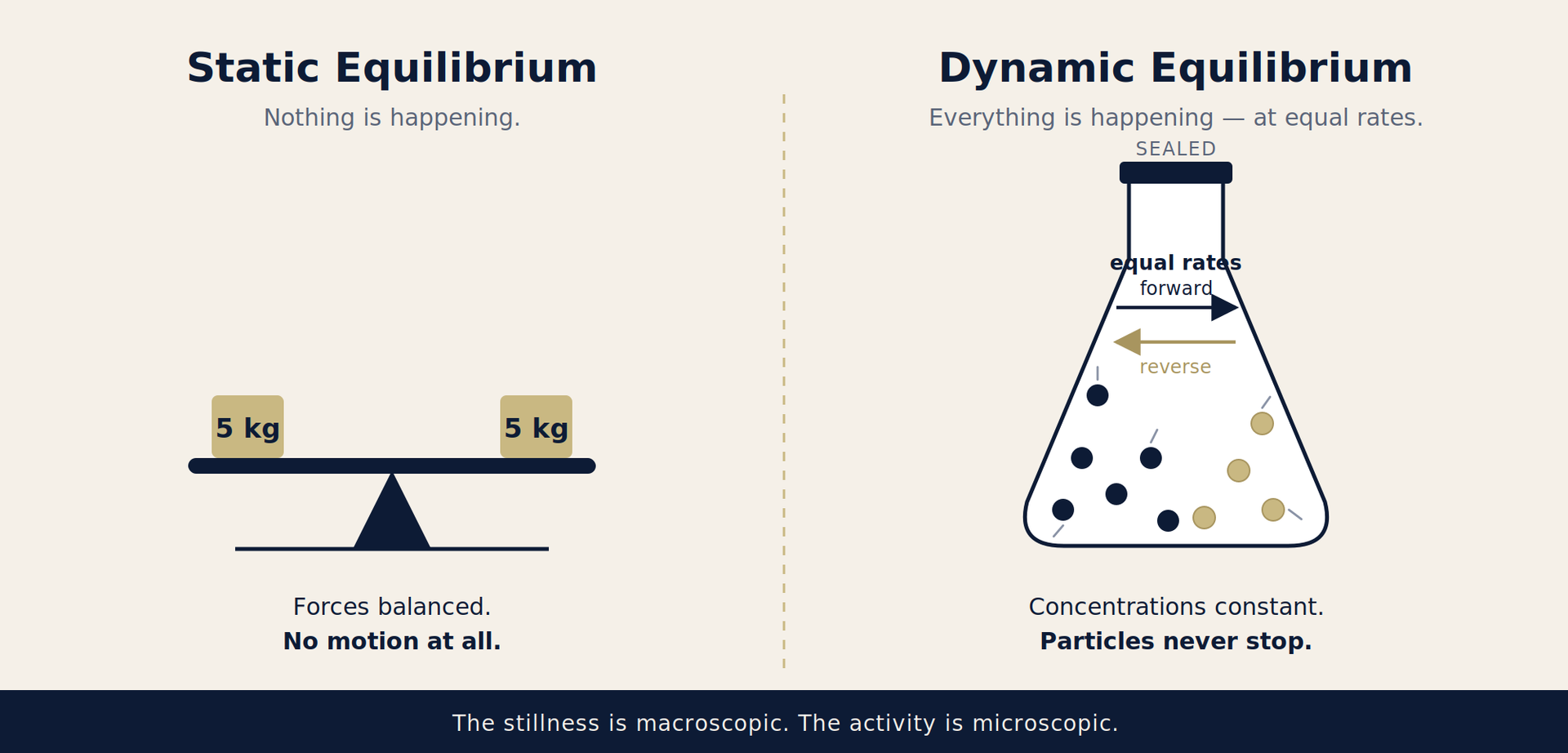
- The Reality: Equilibrium refers to equal rates of the forward and reverse reactions.
- The Trap: Looking for a 1:1 ratio in a graph of concentration vs. time.
- The Diagnostic Fix: We emphasise that the equilibrium constant (Keq) can be any value—very large, very small, or near one—and that 'stability' does not mean 'equality' of amount.
Misconception 2: Misinterpreting the Reaction Quotient (Q)
The reaction quotient, Q, is a snapshot of a system at any given moment. Students often struggle to differentiate Q from K. They might calculate Q correctly but fail to explain what the relationship between Q and K means for the direction of the reaction. If Q < Keq, the system 'needs' more products to reach equilibrium, meaning the forward reaction is favoured. Understanding this requires a solid grasp of the symbolic representation of the law of mass action.
Misconception 3: The logarithmic confusion of pH
When students move into the acid-base portion of Module 5, the mathematics of -log10[H+] often causes a disconnect. Because the pH scale is logarithmic, a change of one pH unit represents a tenfold change in acidity. Students frequently underestimate the physical significance of a 'small' pH change from 2 to 3. Furthermore, they often forget that the auto-ionization of water is temperature-dependent, meaning pH = 7 is only 'neutral' at exactly 25°C. At Tutorio Tutoring, we use specific diagnostic questions to test whether a student truly understands the scale or is simply hitting the 'log' button on their calculator without thinking.
Why do students struggle with buffer solutions?
Buffer solutions are the pinnacle of Module 5 complexity. A buffer is a mixture of a weak acid and its conjugate base (or vice versa) that resists changes in pH. The common misconception here is that a buffer 'stops' the pH from changing entirely. It does not; it merely minimizes the change. Students also frequently fail to identify which species are present in the 'buffer zone' of a titration curve, often confusing the equivalence point with the half-equivalence point.
Misconception 4: Buffers are always neutral
Many students intuitively feel that a 'balanced' system like a buffer should have a pH of 7. This is incorrect. A buffer's pH is determined by the pKa of the weak acid involved and the ratio of the components. A buffer can be effective at a pH of 4 or a pH of 10, depending on the chemical system.
- Key Takeaway: Buffers maintain a specific pH range, not necessarily a neutral one.
- Practical Strategy: Use the Henderson-Hasselbalch equation to see the relationship between concentrations and pH.
Misconception 5: Confusing Reaction Rate with Equilibrium
This is a classic 'cross-module' error. Students often think that because a reaction has a high Keq (it is thermodynamically favorable), it must also happen quickly. This is not true. A reaction can be 'spontaneous' and favor products heavily at equilibrium but take years to reach that state.
- Equilibrium (K): Tells us how far the reaction goes.
- Kinetics (Rate): Tells us how fast the reaction goes.
- The Conflict: Increasing temperature increases both the rate and (usually) shifts the equilibrium. Distinguishing between these two effects is a hallmark of a top-tier HSC student.
Diagnostic Reasoning in Chemistry Tutoring
At Tutorio, we don't just teach content; we teach thinking. Dr. Andrew Wotherspoon uses diagnostic reasoning to pinpoint exactly where a student’s understanding is breaking down. Is it a mathematical error? A sub-microscopic visualization issue? Or a macroscopic misinterpretation? By identifying the specific 'leak' in their logic, we can fix it permanently rather than applying a temporary 'cramming' patch. This is why our pricing and packages are designed to support long-term conceptual growth rather than last-minute exam panic.
Mastering Module 5 Through Deep Logic
To move beyond rote learning, students need a strategy that prioritizes the 'Why' over the 'How.' If you can explain why a concentration change affects the frequency of effective collisions, you don't need to memorize a table of LCP shifts. You simply derive the answer from first principles. This level of confidence is what separates Band 6 students from the rest of the cohort.
For parents, supporting a Year 12 student involves recognizing that these HSC Chemistry Module 5 misconceptions are a natural part of the learning process. The goal is not to avoid them, but to address them head-on through expert guidance. Our 'Third Space' approach—meeting in the relaxed environment of a Camperdown café studio or online via high-end digital tools—provides the perfect atmosphere for these complex ideas to click into place.
Core Takeaways for Module 5 Success:
- Equilibrium is Dynamic: Particles never stop moving; the rates of forward and reverse reactions just happen to balance out.
- LCP is a Response, Not a Reset: The system opposes the change but cannot return to the original state entirely.
- Johnstone’s Triangle is Essential: Always visualize the molecules, not just the numbers in the equation.
- Buffers are Ratios: The pH of a buffer is about the balance between an acid and its conjugate partner.
- Rates $ eq$ Extent: Fast reactions aren't always complete, and complete reactions aren't always fast.
If you or your child are feeling overwhelmed by the complexities of chemical equilibrium or acid-base calculations, remember that clarity is only a diagnostic session away. You can view our resources and store for additional study aids or contact us to book a session in our Camperdown studio or online. Mastering the HSC is about building a foundation of logic that will serve you well into university and beyond.